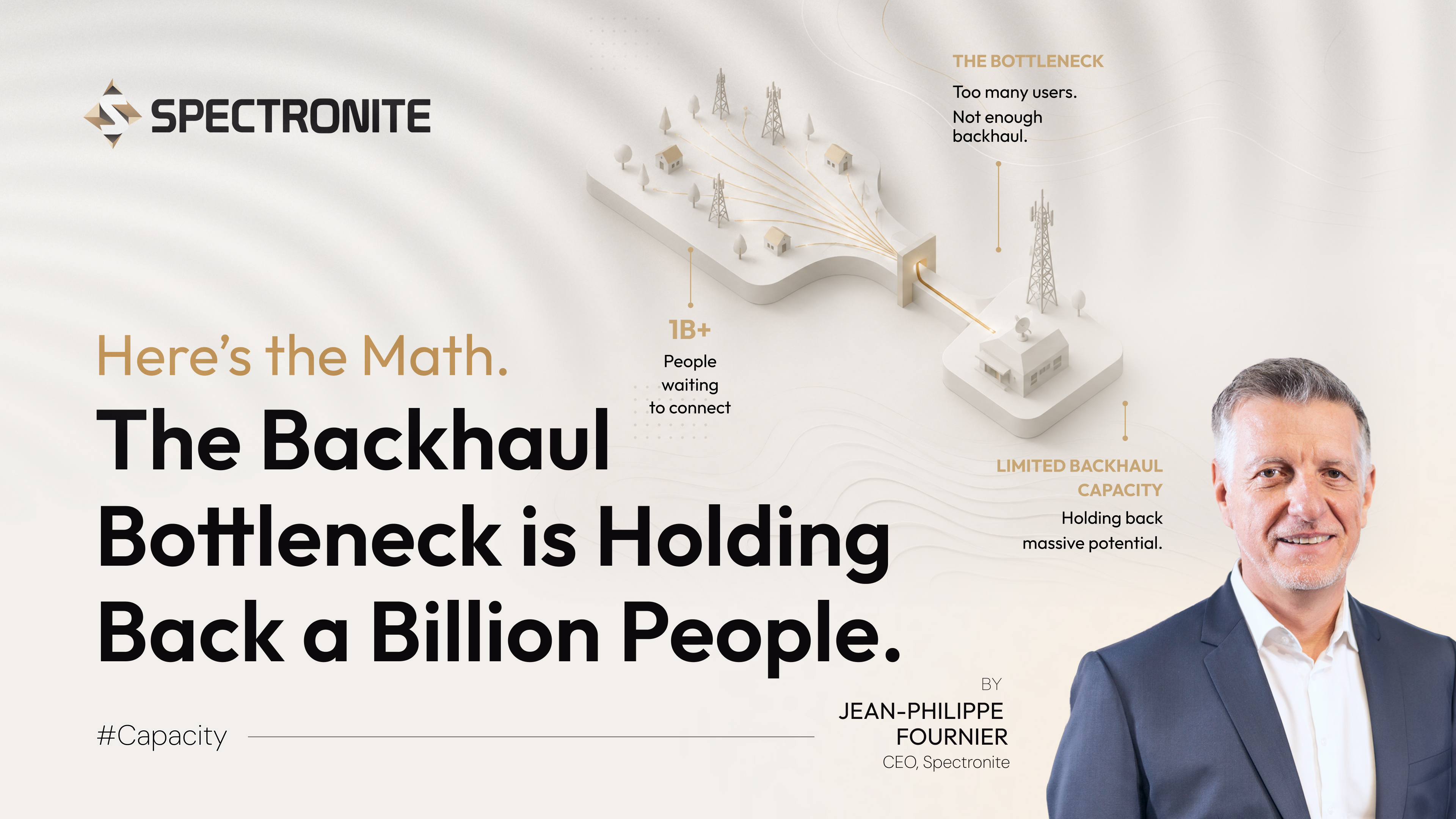
There is a statistic that should trouble anyone who cares about global connectivity. More than 700 million people in Sub-Saharan Africa still lack reliable broadband access. Across Latin America, the urban-rural digital divide continues to widen. Mobile data demand in both regions is growing at double-digit rates. 5G networks are being planned and deployed. The appetite for connectivity is enormous and accelerating.
Yet a critical piece of infrastructure stands between this demand and its fulfilment: the backhaul. And for most operators in emerging markets, the backhaul they have today was designed for a level of demand that is already in the past.
The arithmetic of legacy backhaul
Let me walk through the math. A traditional microwave backhaul radio handles one or two RF channels. To deliver the capacity required for 5G services, an operator would need to deploy roughly ten times more radios than a single modern alternative can provide. Ten times more power consumption. Ten times more hardware to maintain, more spare parts to stock, and more truck rolls to service.
For an urban tower in Lagos or São Paulo, this is expensive but technically feasible. For a rural tower in the Sahel, the Peruvian highlands, or the Brazilian interior, it is economically impossible. The revenue per subscriber in these areas is a fraction of what it is in dense urban centres. The power infrastructure is unreliable or nonexistent. Many sites depend on solar panels or diesel generators, where every additional watt of equipment power consumption directly increases operating cost.
This is why large parts of Africa and Latin America remain unconnected. Not because the demand is absent. Not because the spectrum is unavailable. Because the economics of delivering backhaul capacity with legacy equipment do not work in low-ARPU, off-grid, high-distance environments. The math simply does not close.
Inverting the equation
Now consider a different scenario. One radio. 32 RF channels aggregated digitally. 5 Gbps of throughput. 100 watts maximum power consumption. 8 kilograms. Zero RF power loss.
This is the Spectronite X-Series. And when you run the numbers with this technology, the equation inverts.
Power consumption drops by a factor of ten compared to legacy systems delivering equivalent capacity. A 100-watt radio can run comfortably on a modest solar installation. No diesel dependency. No fuel logistics. No generator maintenance. The carbon footprint falls by a factor of forty. The total cost of ownership drops by a factor of four.
Communities that were too expensive to connect with legacy backhaul become viable overnight. That is not a marginal improvement. It is a structural shift in who gets connected.
This is not just an emerging market story
The innovations demanded by the world’s hardest deployment environments do not stay there. Technology that delivers 20 times the capacity at a tenth of the power, from an 8 kg unit that integrates seamlessly with existing infrastructure, is not a compromise solution designed for challenging conditions. It is a superior architecture that happens to have been forged in them.
European operators face their own backhaul capacity crunch as 5G traffic grows. The energy efficiency, the spectral efficiency, the operational simplicity: these matter everywhere. But they are existential in emerging markets. They are the difference between networks that reach everyone and networks that stop at the city limits.
The proof point
The X-Series has completed a Golden Sample validation with o2 Telefónica, confirming fibre-like wireless capacity, seamless integration, and measurable efficiency gains. It achieves 98% spectrum utilisation and 99.999% link availability. It is designed and manufactured in France, with AI-powered network optimisation and software-defined scalability that allows operators to grow capacity without replacing hardware.
A billion people are waiting for connectivity that legacy backhaul cannot economically deliver. The technology to change that equation exists now. The math works. The question is how quickly the industry is willing to adopt it.