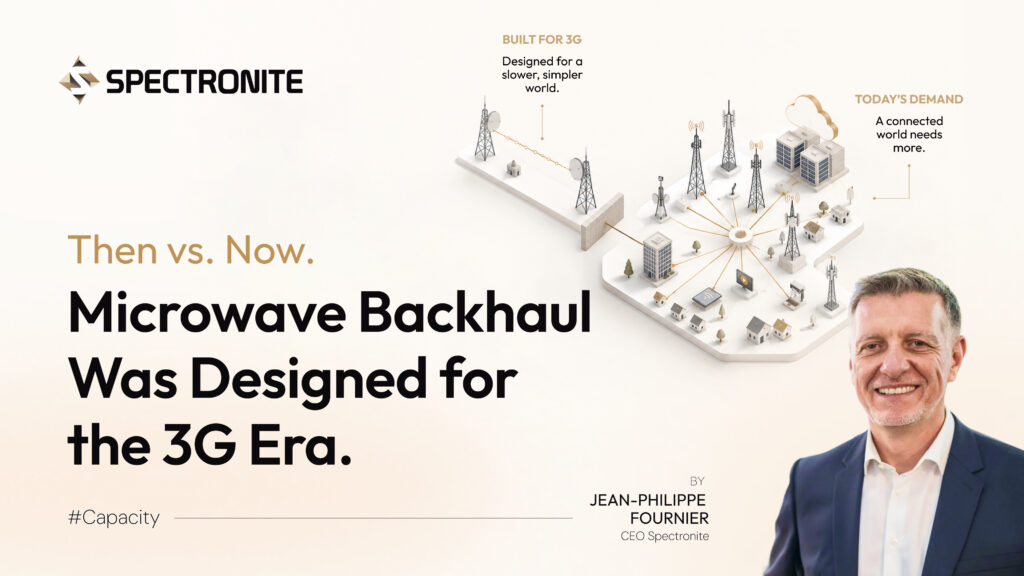
Every industry has assumptions so deeply embedded that people stop questioning them. In wireless backhaul, the foundational assumption has been this: a microwave radio handles one or two RF channels, and if you need more capacity, you add more radios. This principle has guided network design for decades. It shaped procurement processes, tower architectures, power budgets, and vendor roadmaps.
It is also the reason the global backhaul infrastructure is hitting a wall.
The architecture nobody questioned
Traditional microwave radios were engineered around analog signal processing. Each radio manages one or two channels. When operators needed to aggregate channels for more capacity, the industry turned to analog combining: branching units, and combiners that merge multiple signals before they reach the antenna.
This approach has a fundamental physical limitation that the industry has learned to live with, but rarely talks about openly. Analog combining is inherently lossy. The branching units that merge channels absorb a substantial portion of the RF power generated by the radio. Typically, between 75% and 90% of that power is lost before the signal ever reaches the antenna. The radio must compensate by transmitting at higher power, consuming more energy, generating more heat, and requiring more cooling.
For decades, this was accepted as the cost of doing business. The losses were built into link budgets, factored into power calculations, and absorbed into operating costs. Nobody questioned the architecture itself because there was no alternative.
What if you started over?
At Spectronite, we asked a different question. Not: how do we improve analog combining? But: what if we eliminate it entirely?
Digital Carrier Aggregation is our answer. Instead of combining RF channels through lossy analog components, the X-Series processes up to 32 channels in the digital domain, then converts the combined signal to analog in a single stage before it reaches the antenna. No branching units. No combiners.
The result is zero RF power loss. Not reduced loss. Zero. Every watt of transmit power that the radio generates reaches the antenna. This is not an incremental improvement over traditional systems. It is an architectural elimination of a problem the industry had accepted as permanent.
What the numbers look like
A single X-Series radio delivers up to 20 times the capacity of a conventional microwave unit. It achieves 5 Gbps of throughput with 98% spectrum utilisation, using a post-5G waveform that provides 10% greater spectral efficiency than the best legacy radios on the market. It does this in an 8 kg unit consuming a maximum of 100 watts.
To put this in context: achieving equivalent capacity with traditional equipment would require a bank of radios, each with its own analog loss, its own power draw, and its own maintenance cycle. The total power consumption would be roughly ten times higher. The carbon footprint, forty times higher. The total cost of ownership, four times higher.
We did not build a better version of legacy backhaul. We built something that makes the legacy architecture obsolete.
Proven, not theoretical
Earlier this year, the X-Series completed a Golden Sample validation with O2 Telefónica, one of Europe’s leading telecom operators. The test confirmed fibre-like capacity over wireless, seamless integration with existing transport infrastructure, and measurable energy and cost savings. Dr. Andreas Jungmaier, Head of Transport Network Engineering at o2 Telefónica, described the approach as exciting, noting it allows them to build even more powerful transport networks for the future.
Extended field trials and preparation for commercial deployment are now underway. The X-Series is designed and manufactured in France, operates across frequency bands from 6 to 23 GHz, and supports all major ETSI and ANSI channel configurations.
The industry built microwave backhaul for the 3G era and has been patching it ever since. The capacity demands of 5G and beyond require a fundamentally different architecture. Not wider channels bolted onto the same lossy foundation, but a clean redesign from the signal up. That is what we built.