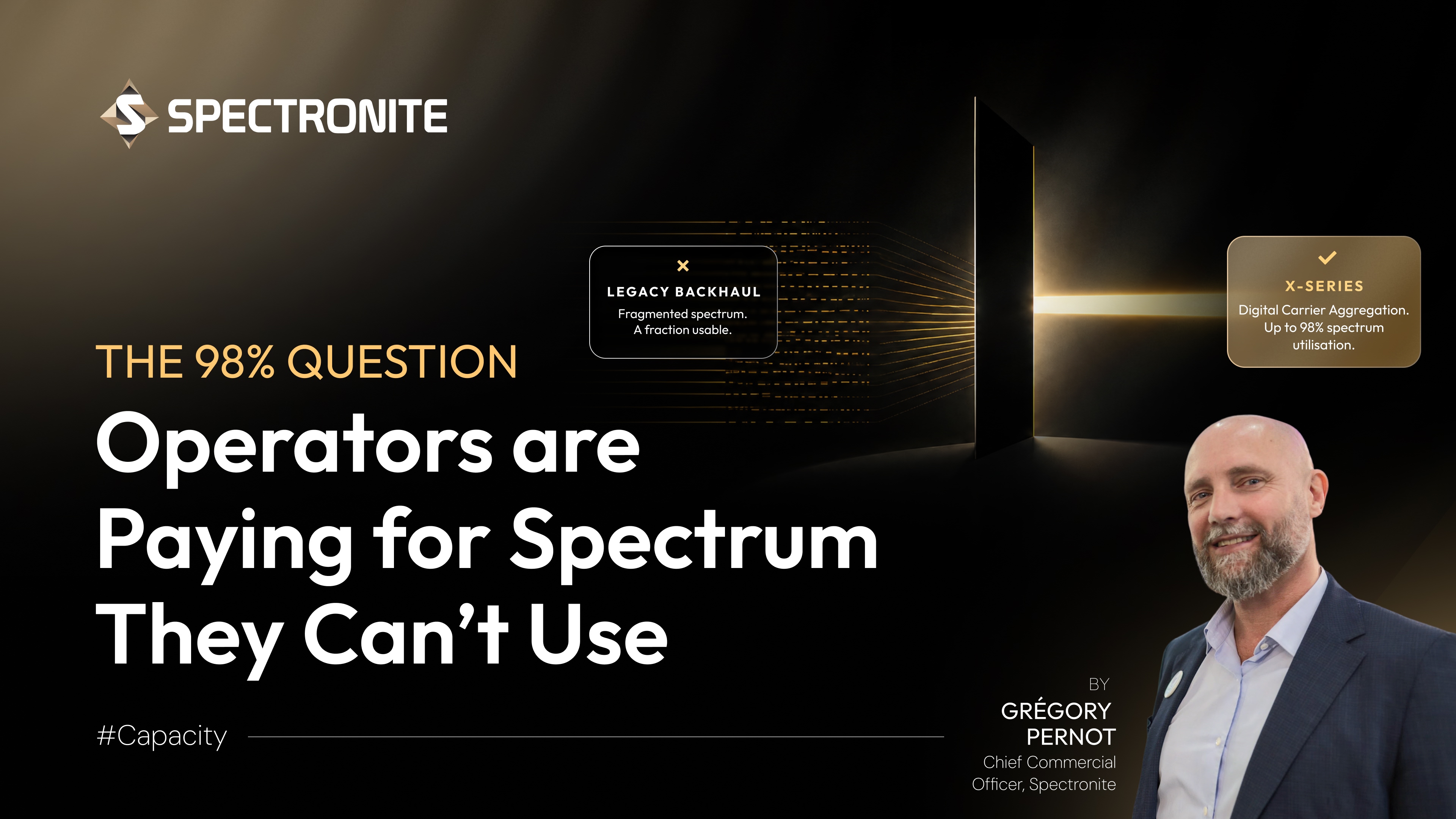
I spend a significant part of my time talking to operators in Africa, Latin America, and Europe. The conversations vary by market, but one frustration comes up almost everywhere: spectrum utilisation. Operators have invested heavily in spectrum licences. In many cases, these licences represent one of the largest capital expenditures on their balance sheet. And yet, the majority of them are unable to extract full value from the spectrum they have paid for, because their backhaul equipment cannot efficiently use it.
This is not a technology problem in the abstract. It is money sitting on the table, every quarter, unused.
Where the waste happens
Every spectrum licence comes with a defined channel. Traditional microwave modems occupy only between 80% and 90% of that licensed channel, a limitation of older modem generations. The remaining 10–20% is left unused. Operators are paying for a channel and transmitting through only a fraction of it.
The commercial consequences compound over time. Spectrum licences are long-term assets, often held for a decade or more, and in markets where spectrum is scarce and auctioned at significant cost, every quarter spent on legacy backhaul is a quarter of licensed capacity left on the table. This is not a minor inefficiency. It is a structural drag on returns.
The problem is not unique to any one region. Operators in Nigeria, Brazil, and across Europe face the same constraint: equipment that was not designed to fully exploit the spectrum it operates in. That gap has been accepted for years as an unavoidable trade-off. It does not have to be.
Using what you have already paid for
At Spectronite, we approached this problem at the architectural level.
Our technology achieves close to 98% channel occupation, compared to 80–90% for legacy modems. This is not an incremental improvement on existing architecture. It is a fundamentally different approach to how a radio uses its licensed channel, one that ensures operators are transmitting across virtually the entirety of the spectrum they have paid for.
The practical results are immediate: more capacity from the same licensed spectrum, with greater range and stronger performance in difficult conditions. For operators who have long accepted that a portion of their spectrum investment would remain stranded inside underperforming equipment, the X-Series changes that calculus entirely.
The commercial case is immediate
The X-Series delivers up to 5 Gbps of throughput over distances exceeding 50 km, with power consumption of just 100 watts. Total cost of ownership drops by a factor of four compared to legacy systems delivering equivalent capacity. It is not about acquiring new spectrum. It is about extracting full value from what you already own.
The X-Series is designed and manufactured in France, built to stringent European standards, and validated by Tier 1 operators.
A question worth asking
The next time your procurement team evaluates backhaul equipment, ask one additional question: what percentage of our licensed channel will this equipment actually allow us to use?
For most legacy radios, the honest answer is 80 to 90%. For the X-Series, it is 98%.
The spectrum is yours. You paid for it. The question is whether your equipment lets you use it.